
Frameworks
The thinking behind every programme.
For L&D and HR teams who want to see how the work is built. Each framework below is one we use on every engagement, with what it is, how it works and a worked example. The names are our own; the ideas draw on theatre, music and the research on arts-based learning.
Framework 01 · The whole map
The W.I.P Rehearsal Method.
Five stages, named in the language of a theatre production. Each stage closes with a gate: a named decision, with a named deliverable, that must be passed before the next begins. The most expensive mistakes in this work happen when a stage is skipped quietly, so the gates make shortcuts visible.
- G0
Qualify
A first call decides whether art is the right tool at all.
- 1
Diagnose
Room Tone. Output: the one-page Diagnostic Brief. Gate G1: brief signed by the sponsor.
- 2
Cast
The Patchbay and the CAST rubric. Output: a named facilitator with a written reason. Gate G2: cast confirmed.
- 3
Devise
Module design on the 4W Arc, presented at a Pitch-back in three depths (the Pool), then Track Changes with the artist. Gate G3: design approved by the client; dry run before delivery.
- 4
Rehearse
Delivery, opening with the ADDA Agreements. Output: observation data and the Commitment Log. Gate G4: delivered.
- 5
Review
The Afterlife Ladder. Output: the Post-Delivery Report and 30 to 90 day follow-up. Gate G5: report accepted.
The thread that runs through it
The 3 to 5 indicators agreed with the sponsor at Gate G1 are the indicators reported at Gate G5. You never receive a report measured against criteria chosen afterwards. Research on artistic interventions in organisations found that success criteria were rarely set in advance, and that effects fade without leadership follow-up (Berthoin Antal and Strauß, 2013). The method is built on that finding.
The Third Chair: our role
Picture the meeting table: the client's chair, the artist's chair, and ours between them. You own the problem, access to people and the follow-through. The artist owns the craft in the room. We own the diagnosis, the design, the casting, quality and the review. A CHRO says "we need our managers to be more inclusive"; a theatre director hears a request for a play about inclusion. Translating one into a rehearsable behaviour, and that behaviour into an artistic exercise, is skilled work. The third chair makes it somebody's job.
Framework 02 · Diagnose
Room Tone.
On a film set, before anything is shot, the sound crew records "room tone": the sound of the room with nobody speaking, so they know what is really there underneath the dialogue. A good diagnosis works the same way. Room Tone reads a team through four lenses and produces one page.
- R
Room
Who is in it? Hierarchy, gender ratio, generations, languages, who speaks first and who is usually absent. A team that waits for the senior person to speak is not a team of shy people.
- A
Act
What do people actually do? Something a camera could record. "Managers are not inclusive" is a judgement; who is handed the difficult assignments at the end of the Monday review is an act.
- S
Stakes
Why now, what it costs, who is accountable, and what has already been tried. If awareness training and a speaker changed nothing, the problem is a behaviour, not a knowledge gap.
- A
Aesthetic fit
Which artistic discipline already trains this behaviour, and what constraints shape the art: group size, schedule, language, a venue with no open floor.
The Behaviour Statement
When [situation], [who] [does what], which costs [what]. We want to see [alternative behaviour] instead.
These statements are illustrative composites, not records of client work.
The five diagnostic tools
| Tool | Who | Time |
|---|---|---|
| Intake call | HR, L&D or a business head | 30 minutes |
| Sponsor interview | The person who owns the problem | 45 to 60 minutes |
| Participant pre-pulse | All intended participants, online | 8 to 10 minutes each |
| Participant conversations | 5 to 8 people across levels | 20 to 30 minutes each |
| Shadow Brief | One real meeting of the team | The meeting plus 30 minutes |
We use at least three. A brief built only on the sponsor's account is one person's view.
The output: one page
The Diagnostic Brief holds the request as received, the sources, the four lenses, the Behaviour Statement, what we observed, 3 to 5 indicators with who collects each and when, risks and safeguards, and a recommendation. One page is a discipline: a sponsor will sign one page and skim five. See the worked example.
Framework 03 · Cast
The Patchbay and the CAST rubric.
In a studio patchbay, each sound source is patched to the right output. Here the sources are artistic disciplines and the outputs are workplace behaviours. The Patchbay is a design heuristic built from our artists' practice and the literature on each discipline. It is a structured way of asking: which practice has spent generations working on this exact behaviour?
| Discipline | Voice and presence | Listening | Turn-taking and airtime | Leading and following | Recovering from the unexpected | Status and power | Collaboration and ensemble | Ambiguity and experimentation | Attention and recovery | Narrative and persuasion |
|---|---|---|---|---|---|---|---|---|---|---|
| Theatre and forum theatre | ○secondary | ○secondary | ○secondary | ●primary | ○secondary | ●primary | ||||
| Improvisation | ○secondary | ○secondary | ●primary | ●primary | ○secondary | ●primary | ||||
| Physical theatre and voice | ●primary | ○secondary | ●primary | ○secondary | ○secondary | |||||
| Hindustani and ensemble music | ●primary | ○secondary | ●primary | ●primary | ○secondary | ○secondary | ||||
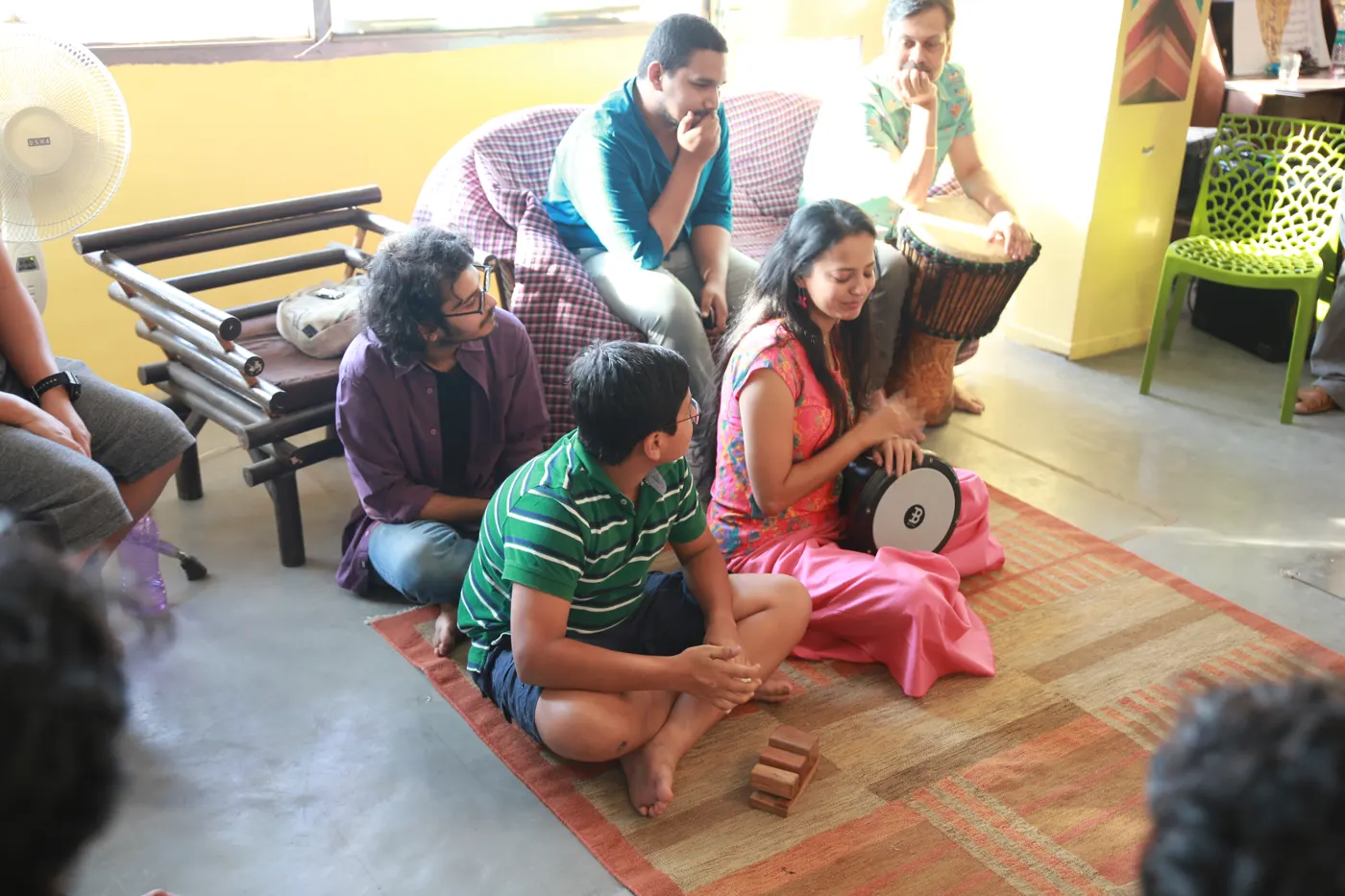
| Percussion and rhythm | ○secondary | ●primary | ○secondary | ●primary | ○secondary | |||||
| Movement and Kalaripayattu | ●primary | ○secondary | ○secondary | ●primary | ||||||
| Somatics | ○secondary | ○secondary | ○secondary | ●primary | ||||||
| Puppetry | ○secondary | ○secondary | ●primary | ●primary | ||||||
| Sound design and deep listening | ●primary | ○secondary | ○secondary | ●primary | ||||||
| Live coding and creative coding | ○secondary | ○secondary | ○secondary | ●primary | ||||||
| Visual art and making | ○secondary | ●primary | ○secondary | ○secondary | ||||||
| Film and storytelling | ○secondary | ○secondary | ○secondary | ●primary |
● primary fit: the discipline trains this behaviour directly ○ secondary fit: it touches the behaviour as a by-product
Forum theatre · status and power
A group can stop a scene, replace a character and test a different move, so power in a real situation becomes visible and changeable (Boal; in India, Jana Sanskriti).
Improvisation · recovering from the unexpected
The core move is to accept an unexpected offer and build on it, which is exactly what an objection or a surprise in a meeting needs.
Ensemble music · leading and following
An ensemble depends on passing the lead; nobody can hold the music alone. In sawal-jawab and jugalbandi you cannot answer a phrase you did not hear.
Percussion · turn-taking and airtime
Rhythm makes entries, gaps and dominance audible. Who plays over whom can be heard by everyone at once.
Kalaripayattu · attention and recovery
Grounding, weight and an all-round, embodied attention: the physical basis of being steady in front of others.
Live coding · ambiguity and experimentation
Live coders decide second by second when to let a system run and when to step in. That is the AI question too.
Then the person: the CAST rubric
Once the discipline is chosen, we choose the facilitator, scored from 1 to 4 on four dimensions.
- C
Craft
Depth and standing of the artistic practice.
- A
Applicability
How directly their discipline, as they practise it, trains the diagnosed behaviour.
- S
Steadiness
Holds a room safely, handles discomfort, knows when to stop, is reliable.
- T
Translation
Connects the exercise to working life, without jargon or contempt for business.
Casting rules: Steadiness never below 3. A lead never below 12 of 16. Every lead artist paired with a W.I.P learning lead. One accountable lead per programme, with a written casting note and a second option; inclusion work adds a co-lead of a different gender.
Framework 04 · Devise
The 4W Arc.
The structure of every session, whatever the art form: Warm, Wobble, Work, Walk-out. The largest share of time goes to Work, because repetition is where behaviour changes.
- 15%
Warm
Agreements and grounding, so everyone is on the same footing before anyone is asked to risk anything. This is neither compliance training nor a tribunal.
- 25%
Wobble
The behaviour made visible, and a little uncomfortable, using the room's own conduct: never tell people something about themselves that the room can show them instead.
- 45%
Work
The alternative practised several times, with notes, the way a theatre company rehearses: run, note, run again.
- 15%
Walk-out
Specific, dated commitments, recorded in the Commitment Log and handed to the organisation.
Rules of thumb
- The split is a default, not a law; we write down any reason to change it.
- Never cut Work to make room for content. If time is short, cut explanation first.
- Walk-out is never optional, even in a half-day. Without it, a session ends as an experience, not a change.
- Early exercises happen all together, in pairs or in pods, before anything is done in front of the whole room. Senior people take exposed roles first.
- A two-day programme has a large arc too: day one leans to Warm and Wobble, day two to Work and Walk-out.
The Module Card
Every module is written on one card before a session plan exists: the Behaviour Statement, 2 to 4 learning objectives written as observable behaviour ("participants will be able to..."), the discipline and why, the 4W Arc for the session, the tools, the indicators and the safeguards. It is what you approve at the Pitch-back.
Framework 05 · Devise, with the artist
Track Changes.
Think of a shared document with track changes switched on. We write the draft; the artist marks it up; we accept, adapt or reject each change, with a reason. The text gets better in the exchange, and nothing is final until the changes are accepted.
- 1
Draft
We send the artist a briefing pack: the Diagnostic Brief, the Module Card and the context of your organisation.
- 2
Mark-up
The artist suggests what to change, add or cut, and why. They know their craft far better than we do.
- 3
Accept, adapt or reject
We decide each suggestion and log the decision with a reason. The spine is locked: objectives, the arc, the tools, the indicators and the safety rules.
- 4
Run-through
A dry run and a technical run: cues, timings, roles and the stop signal. The artist delivers only after this.
Equal in respect, clear in decision rights
The artist and W.I.P are equal in expertise: the artist in the craft, W.I.P in your problem and the design you approved. Decision rights are not equal: we are accountable to you for the design, so we decide. Saying this at the start prevents most difficult conversations later.
Why understanding the diagnosis matters
An artist who has understood the diagnosis makes hundreds of good decisions in the room that no run sheet could specify: when to stop an exercise, whose offer to build on, which scene to replay. That is why Track Changes includes a check that the artist can explain your diagnosis back in their own words.
Framework 06 · Rehearse
The ADDA Agreements.
Adda is the Bengali tradition of open conversation among equals. Every session opens with four agreements, said aloud, written on the wall and checked with the group, never emailed in advance as rules. Facilitators may say them in Hindi, English or a mix, but the four meanings stay intact.
- A
Ask, don't assume
If an instruction is unclear, ask. When you see a colleague do something today, ask about it before you decide what it meant.
- D
Dignity first
Nobody will be made the example. Nobody has to share a personal story. Patterns are looked at in the whole room, never in one person.
- D
Do it, then discuss
We try things before we talk about them. Opinions are welcome, after trying, because that is when they are worth most.
- A
Anyone can pause
A raised open palm stops the room, for any reason, without explaining. Participation is by invitation: anyone can watch instead, with a useful role.
Before the agreements
The sponsor speaks first, for two minutes: why the organisation is investing in this, that it is not an assessment, and that they are open to what comes out of it. Then they hand over.
What we never promise
We promise that W.I.P reports patterns, never individuals, and that observations are never used for appraisal. We do not promise what colleagues will say to each other at lunch, and we say so plainly if a group asks.
Framework 07 · In the room
Signature tools.
Exercises we designed or adapted, each tied to a behaviour and to a movement of the 4W Arc. Every tool has a purpose, a set of steps, debrief questions, the data it captures and its safeguards. A selection:
Diagnose
The Shadow Brief
We sit in one real meeting before designing anything, so the brief rests on observation and not only on what the sponsor says.
Wobble · measurement
The Floor Audit
Observers code a live discussion: who speaks first and longest, who is interrupted and by whom, whose ideas are restated or credited to someone else. Played back as a picture: patterns, not people.
Wobble
Nine Seconds
A leaderless task with a marker in the middle of the table. Who picks up the pen, stands at the front and gives the summary, and how fast. Then rerun with roles allocated deliberately. Results are shown as a pattern across groups; nobody is named, and no woman is the only woman in her group.
Wobble
The Mirror Scene
Artists play one of the group's own real moments back to it, so people see a pattern from outside without anyone being identified or accused.
Wobble
The Status Walk
Status made visible as something people do with their bodies, voices and space, rather than something they have.
Warm
The Listening Round
Every voice is heard once before anyone is heard twice. It slows the room down from the first minutes.
Warm
The Taal Circle
A shared pulse in a group of non-musicians, showing that coordination depends on listening, not on a leader.
Work
The Register Switch
The same feedback delivered to two different colleagues, performed and played back, so people hear how a message changes with who receives it.
Work
Stop and Replay
A difficult situation is stopped and replayed with a different move, to test alternatives by doing them rather than discussing them.
Work
Pass the Lead
Leading, following and handover made explicit in music, where nobody can hold the piece alone. Senior voices learn to create space rather than fill it.
Work
Say It Back
Accurate paraphrase before adding one's own view, to reduce talking past each other.
Walk-out
The Commitment Log
Every commitment, specific and dated, held by HR rather than by a participant's memory, and reviewed at 30 to 90 days.
Between sessions
The Observation Week
Three narrow prompts carried into a normal working week between two workshop days, so day two works with real material.
For longer engagements: the Creative Cultural Audit
We find out how people actually behave in rooms together, not what surveys report. Interviews, facilitated observation and a qualitative survey feed the Culture Map, which becomes the organisation's own reference point for the year.
| Dimension | Absent | Emerging | Developing | Embedded |
|---|---|---|---|---|
| Voice and participationWho speaks, who is heard, who defers | Some groups routinely dominate. Interruptions go unremarked. | Some advocates for equal participation, but it depends on the manager. | Broadly encouraged. Meeting norms exist. Quieter voices still struggle. | All voices actively drawn out. Leaders model listening. |
| Power and hierarchyHow rank shapes communication | Hierarchy is rigid. Junior staff never challenge upward. | Some open teams, but power differentials dominate most interactions. | Upward communication possible. Structural deference remains. | Power exercised with accountability. Dissent is safe and valued. |
| Psychological safetyWhether people can speak and fail honestly | People self-censor routinely. Honesty is a career risk. | Safety exists in close teams. Candid in private, not in rooms. | Most feel they can raise concerns. Sensitive issues remain unsafe. | People name problems without fear. Failures discussed openly. |
| Representation and visibilityWhether diverse identities are seen and valued | Absent at senior levels. Difference ignored or treated as exceptional. | Present at junior levels. Senior leadership remains homogeneous. | Acknowledged, but visibility is uneven across groups. | Diverse identities present at all levels. Difference is an asset. |
| Peer support and solidarityWhether colleagues support each other across difference | No culture of allyship. Support is transactional. | Some individual allies. No shared language for support. | Some peer support culture. Cross-group solidarity is weak. | Allyship practised across difference, with a shared language. |
Baseline audit
Scoping, structured interviews across cohorts, observation sessions and a survey. Produces the first Culture Map, a synthesis report and a recommendations brief that shapes the intervention.
Mid-point pulse
A compressed check-in once workshops are under way. An updated map shows what shifted, what did not, and what to adjust.
End-of-year review
The full audit repeated with the same instruments, so all three maps can be read side by side, with recommendations for year two.
Framework 08 · Review
The Afterlife Ladder.
What survives of a workshop after everyone goes home? The Afterlife Ladder climbs from the room to the organisation. It builds on Kirkpatrick's four levels, which most L&D teams already use, adds one level of our own for team dynamics, and deliberately stops short of a return-on-investment figure.
| Level | What is measured | How | When | Who collects | What we can honestly claim |
|---|---|---|---|---|---|
| 5 · Organisational indicators Kirkpatrick 4 | Business-level signals chosen per brief | For example assignment distribution, attrition in a segment, engagement items, pitch win rate | 3 to 12 months | You | Tracked by you; never claimed by us |
| 4 · Application at work Kirkpatrick 3 | Use at work | Self-assessment on named situations, manager observation, Commitment Log completion | 30 to 90 days | Your HR with W.I.P | Reported as association, not cause |
| 3 · Team dynamics Our addition | How the group works together | Floor Audit, Nine Seconds, ensemble observation | During, and in one real meeting after | W.I.P, then HR | Reported, as a snapshot |
| 2 · Behaviour in the room Kirkpatrick 2 | Change during the programme | Facilitator coding, first versus final run | During | W.I.P | Patterns, never individuals |
| 1 · Response Kirkpatrick 1 | Relevance, safety, intent to apply | Exit survey with specific items | End of programme | W.I.P | Reported directly |
How it maps to Kirkpatrick
Our rung 1 is Kirkpatrick's reaction, rung 2 is learning shown as behaviour in the room, rung 4 is behaviour at work (Kirkpatrick 3) and rung 5 is results (Kirkpatrick 4). Rung 3 is our addition: artistic formats make group behaviour unusually observable, so we capture team dynamics directly. We understand Phillips' fifth level, return on investment, but a currency figure from a single programme would be invented.
Three things we never do
- No invented ROI. Too much else moves at the same time.
- No individual assessment. If observations reached appraisals, the room would stop being honest and the data would stop being true.
- No "people loved it" as evidence. Most people enjoy artistic work. We report behaviour, not applause.
Framework 09 · The proposal
The Pool.
Every proposal offers three depths, so you choose how far to go and the trade-offs are explicit, rather than a yes or no on a single price. A fixed-fee diagnostic comes first and is credited if you go ahead. Each option is priced per programme for a stated group size; venue, travel and logistics are a separate line.
Programme only · the Shallow End
The programme
The programme as designed, with response and in-room data (rungs 1 and 2) and a short report.
What it cannot show: change at work, because it includes no follow-up there.
Programme and review · the Deep End · what the method is built for
Programme, Observation Week and Review
The programme, split by an Observation Week where the design allows, a full Post-Delivery Report and one review against the indicators.
What it shows: evidence on rungs 1 to 3 and a first look at application at work.
Programme, review and 90-day follow-up · the High Dive
The Deep End, plus 90 days
Everything in the Deep End, plus a 90-day follow-up against the indicators and a second, shorter session to rehearse what did not stick.
Why: follow-up is where effects are kept or lost.
If you choose the Shallow End, we deliver it well and say plainly, in the proposal and the report, what it can and cannot show.
Framework 10 · Everything together
A worked example, end to end.
An illustrative brief, not a client record, showing how the frameworks connect. An auto-components manufacturer in Pune asks for "a speak-up culture workshop for our engineers before the new platform launch."
Diagnose (Room Tone)
Room: 24 engineers across three levels; the Head of Engineering chairs the weekly design review; four women; Marathi, Hindi and English, with the review held in English, which juniors find slower to argue in; juniors sit along the walls. Act: in one observed review, the chair spoke first on every item, engineers mostly agreed with the senior view, and two risks were raised only in the corridor afterwards. Stakes: late design changes traced to risks juniors knew about; an e-learning module and a town hall changed nothing. Aesthetic fit: turn-taking, leading and following, status.
When the weekly design review raises a quality or timeline risk, junior and mid-level engineers stay silent or agree with the most senior view, and raise concerns later one-to-one, which costs rework discovered late. We want engineers to name the risk in the review itself, and senior engineers to invite and build on it before giving their own view.
Indicators, agreed before design
- Team dynamics: share of agenda items where a non-senior engineer makes the first substantive contribution, baseline and at 60 days.
- Application at work: pulse item "In our design review, I can raise a risk without it being held against me", baseline and at 60 days.
- Application at work: senior engineers' completion of logged commitments at 90 days.
- Behaviour in the room: how often the senior role invites a view before giving its own, first versus final run of the review scene.
- Organisational, tracked by the client: risks recorded in review minutes by someone other than the chair.
Cast (the Patchbay and CAST)
Ensemble music improvisation as lead discipline (leading and following; nobody holds the music alone), with forum theatre in support (status). No arts experience needed; nothing depends on English.
Devise (the 4W Arc and the Pool)
Two days a week apart with an Observation Week between. Day one leans to Warm and Wobble: the Listening Round, a Floor Audit on a real design question, Pass the Lead. Day two leans to Work and Walk-out: Stop and Replay on the review scene, seniors taking exposed roles first, then the Commitment Log.
Rehearse (the ADDA Agreements)
The Head of Engineering opens, says this is not an assessment, and takes part. Observations are never used for appraisal, agreed in writing.
Review (the Afterlife Ladder)
A report within 10 working days against the same five indicators, and the design review reopened for observation at 60 days.
Want to see these applied to your team?
Start with a 30-minute call. The diagnosis is where the frameworks begin.
Describe your problem Or book a Google Meet, or email usGo deeper.
For L&D, HR and procurement teams who want the detail before the first call.
- ProgrammesSix areas of work and the modules in each, with formats and durations.
- How we workThe engagement step by step: what we do, what we need from HR, what you receive and when.
- Our workCase studies, and the precedents and research behind arts-based learning.
- PeopleThe team who run ART Immersion, the faculty we cast from, and where they have worked.
- FAQSafety, consent, measurement, language, travel, pricing and procurement.