
FAQ
What buyers ask us.
The questions a CHRO, an L&D head, a DEI lead, a business head or a procurement team usually asks, answered plainly.
About the programme
What exactly is ART Immersion?
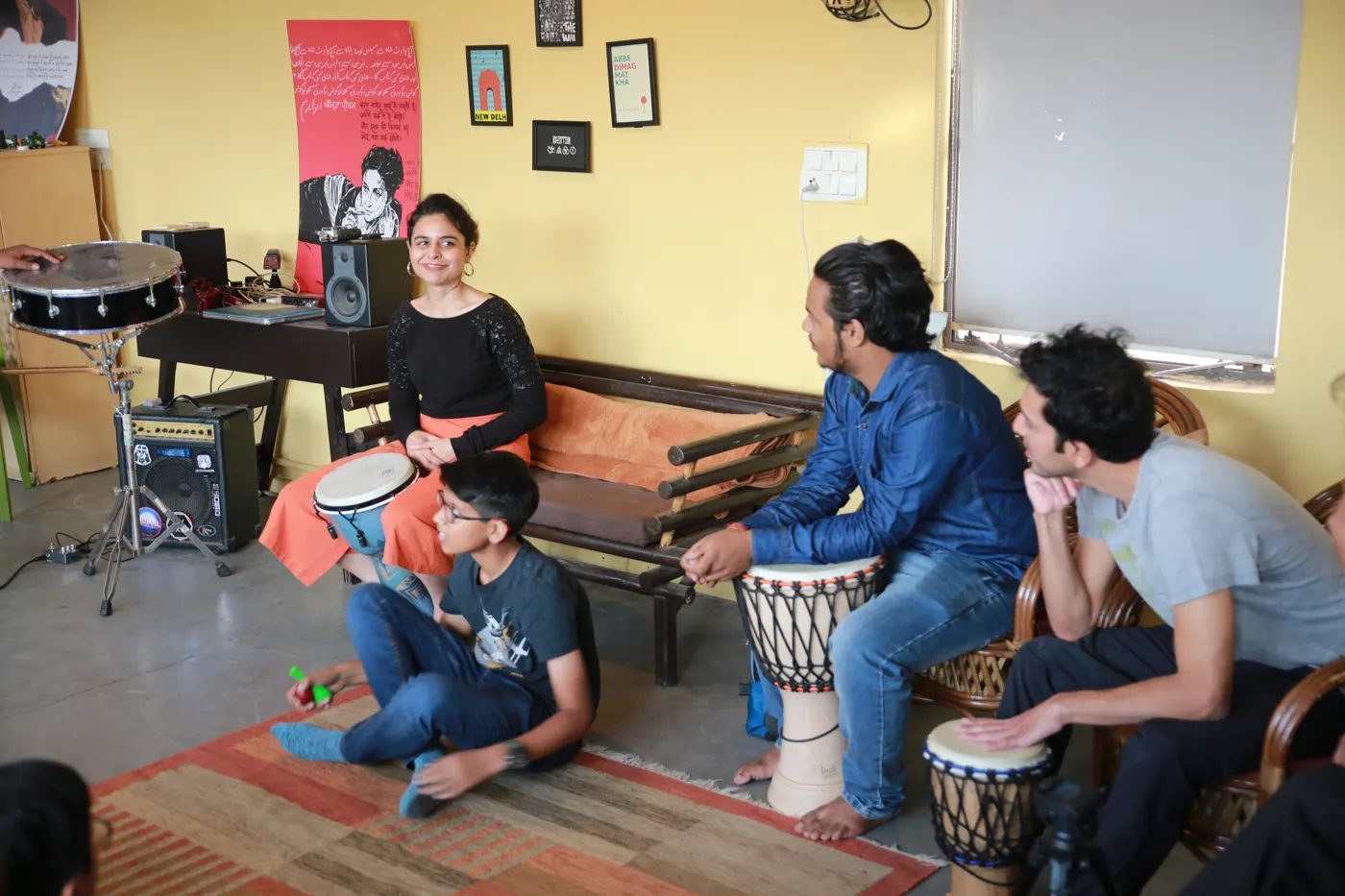
The corporate training programme of W.I.P Labs, an artist-run collective in New Delhi. Working artists from theatre, music, movement, sound and code design and lead programmes that change specific behaviours at work: how people speak up, lead, listen, pitch, include each other and use AI. Every programme starts with a diagnosis with your HR team and ends with a review against agreed indicators.
Why artists, and not a conventional trainer?
If the gap is knowledge, hire the trainer. We work where people already know what to do and still don't do it: interrupting, freezing in a pitch, taking over a room. Those are behaviours. Rehearsal, ensemble, listening, status and improvisation are what artists train in for whole careers, and they change behaviour in real time.
Is this team building?
No. Team building aims at goodwill. We aim at a named behaviour, measured before and after. People often enjoy it, but we don't count enjoyment as evidence.
Our employees are not artists. Will they find it childish or awkward?
They don't need to be artists. Nobody is judged on talent or asked to perform alone; where a format ends in a group performance, such as the Company Song, taking part is optional. The art is the method; the material is your team's real meetings, pitches and conversations. We sequence exposure carefully: early exercises happen all together, in pairs or in small groups, and senior people take exposed roles first.
Can it work for senior leadership?
Often best there. Senior teams are skilled at giving the right answer in a discussion; in rehearsal only the behaviour counts. Leadership Studio is built for top teams of 6 to 16, with senior practitioners.
Can it fit into our existing leadership or DEI programme?
Yes. A single Intervention works well as the practice module inside a longer journey. We can map learning objectives to your competency framework, and our measurement levels map onto Kirkpatrick's, which most L&D teams already use.
Is everything customised, or do you have off-the-shelf modules?
Our modules are starting designs, marked Delivered, Designed or Pilot. Every one is shaped to your brief at the Diagnose stage, using situations from your organisation; none runs unchanged.
Process and timelines
How does an engagement work?
A first call; a paid diagnostic with your sponsor, HR and a sample of participants; a one-page brief with 3 to 5 indicators you sign off; casting of the facilitator; a design you approve; delivery; and a report against the indicators, with follow-up at 30 to 90 days. The full process.
How long from first call to delivery?
Usually 3 to 6 weeks from the diagnosis to delivery, about six weeks from a first call. Large organisations often need longer for procurement and calendars, and residencies need more time. Faster is possible with a compressed diagnostic; we will tell you what that costs in evidence.
How much time does it take from our HR team?
A sponsor interview of 45 to 60 minutes, access to 5 to 8 people for short conversations, a participant pulse of 8 to 10 minutes, one meeting we can observe, a Pitch-back meeting to approve the design, and ownership of the Commitment Log after delivery.
Can you start without a diagnostic?
We design blind without one, so we don't. If time is tight, we run a compressed diagnostic and record its limits in the brief.
What if the diagnosis shows art is not the right tool?
We say so. If the problem is a skills gap, a broken process or a policy question, a workshop would stand in for a decision. We recommend the right help instead.
Facilitators
Who will actually be in the room?
A lead facilitator chosen for your brief from our faculty, named in writing with the reason for the choice, and a W.I.P learning lead. Inclusion programmes always have at least two leads of different genders. Our faculty.
How do you choose and brief facilitators?
We choose the art form first, using the Patchbay, then score candidates on Craft, Applicability, Steadiness and Translation (the CAST rubric). Steadiness, holding a room safely, has a minimum nothing else can make up for. The facilitator works through the design with us round by round, explains your diagnosis back in their own words, and rehearses it in a dry run before delivery.
What happens if a named facilitator becomes unavailable?
We never name a facilitator in a proposal until they have confirmed, and every casting note has a second option, briefed on the same diagnosis.
How do you keep quality consistent across artists and cohorts?
The spine of the design is fixed: objectives, the session arc, the tools, the indicators and the safety rules. Artists bring their craft within that spine, and a W.I.P learning lead is in the room. Facilitators are reviewed after every engagement.
Safety, consent and confidentiality
Will people feel uncomfortable?
Some discomfort is how people see their own patterns; humiliation isn't, and the design prevents it. Every session opens with four agreements: ask, don't assume; dignity first; do it, then discuss; anyone can pause. Nobody is singled out or asked to share a personal story.
Can someone opt out?
Yes. Participation is by invitation. Anyone can watch an exercise instead, with a useful role, and anyone can pause the room without explaining why.
Is there physical contact?
Only where the design needs it. Any exercise involving touch offers a no-touch version first, and consent is checked pair by pair. Mixed-gender groups default to the no-touch version. People can adapt or sit out physical work without disclosing why: injury, pregnancy, disability and fasting are all common and need no explanation.
Is anything shared that could affect appraisals?
No. We record patterns with seat codes, not names, and report in aggregate. Observations are never used for appraisal; the sponsor agrees to this in writing before we start. If a client wants individual scores, we decline that part of the work.
What if someone discloses harassment or distress during a session?
Facilitators are not investigators and the room is not a tribunal. We make sure the person is supported and not left alone, and tell them privately about your routes, including your Internal Committee under the POSH Act. We record that a disclosure was made and what route was offered, never its content, and it never appears in our report.
Who sees photographs, recordings and notes?
No photographs without consent collected that morning, and no filming for marketing. Learning recordings are made only with each participant's consent, never handed to the client, and deleted after the programme unless everyone in them agrees otherwise in writing. Observation data is stored securely and shared with you only in aggregate.
Is this therapy?
No. We work on habits in a group. Where a diagnosis points to clinical needs, we say so and point to professional help.
Measurement
How do we know it changed anything at work?
We agree 3 to 5 indicators with you before we design anything, and report against those same indicators afterwards. We report the first four rungs of evidence ourselves, from participant response to application at work at 30 to 90 days, depending on the option you choose. Business-level results are yours to track; we never claim them as our effect. The Afterlife Ladder.
Will you give us an ROI figure?
No. Too much else moves at the same time, and a rupee figure from a single programme would be invented. We report behaviour, honestly, and help you track the business indicators you choose.
What does the report look like?
A Post-Delivery Report within 10 working days: the indicators, what was observed at pattern level, the Commitment Log, what the evidence can and cannot show, and a recommendation, including when no further work is needed. A worked example.
What reinforcement happens after the programme?
Dated commitments held by your HR team in the Commitment Log, an optional Observation Week between sessions, and follow-up at 30, 60 and 90 days. The deepest option adds a second, shorter session to rehearse what did not stick.
Practicalities
How many people can take part?
12 to 30 per facilitation team, with larger groups working in pods. Leadership Studio is for 6 to 16. Some formats, such as the Company Song, scale to several hundred.
Where do you deliver? Do you travel?
At your office, at W.I.P aDDa in Lado Sarai, New Delhi, or at a residential venue chosen for your brief. We travel to deliver in other cities; travel and logistics are shown as a separate line in the proposal.
What languages do you work in?
Sessions run in English, Hindi or a mix, as the room needs. Language is part of the diagnosis and of casting; tell us early if your teams work in other languages and we will say plainly what is possible.
Can it run online?
The diagnosis and the review, yes. The practice itself is designed for a room.
What do we need to provide?
A room with a clear floor, a sponsor who opens the session, and participant communication sent from your side. We bring the instruments and materials.
Commercials and procurement
How is it priced?
Per programme for a stated group size, not per head. A fixed-fee diagnostic comes first and is credited against the programme if you go ahead. Every proposal offers three depths (the Pool), with venue, travel and logistics shown as a separate line. We share indicative fees on the first call.
Who do we contract with?
Inarbeit Production Pvt. Ltd., the company that operates W.I.P Labs, based in New Delhi. Payment terms, cancellation and rescheduling, confidentiality and safeguarding are set out in the contract.
Who owns the material?
W.I.P keeps its methods, frameworks and tools. You own your outputs: the commitments and charters your teams write. Confidentiality runs both ways.
Will you name us as a client?
Not without your written permission. By default we describe work by sector, scale and problem.
Can we speak to a past client?
Yes, one-to-one, once we are in serious discussion and with that client's permission.
Didn't find your question?
Go deeper.
For L&D, HR and procurement teams who want the detail before the first call.
- ProgrammesSix areas of work and the modules in each, with formats and durations.
- How we workThe engagement step by step: what we do, what we need from HR, what you receive and when.
- FrameworksHow we diagnose, choose facilitators, design sessions and measure, with worked examples.
- Our workCase studies, and the precedents and research behind arts-based learning.
- PeopleThe team who run ART Immersion, the faculty we cast from, and where they have worked.